Indonesia’s K3 compliance framework requires employers to document that safety training has been conducted, that employees have been assessed, and that competence standards have been met. In practice, this documentation typically consists of training attendance sheets signed by participants and instructors, checklist-based competence assessments completed during the training session, and certificates issued upon completion. The regulatory requirement is nominally satisfied.
The underlying question — whether this documentation accurately reflects the actual emergency response competence of the workforce — is rarely examined with scientific rigor. This article evaluates the measurement limitations of conventional K3 fire safety and first aid assessment methodology, and examines how VGLANT’s integrated performance analytics system provides an objective, data-driven alternative that aligns with both Indonesian regulatory requirements and international safety standards.
The analysis draws on assessment science principles and evaluates the specific telemetric capabilities of the VGLANT platform as deployed across Indonesian industrial operations, including those within the Virtu mining and manufacturing network.
The Measurement Problem in Current Indonesian K3 Assessment
Subjective Evaluation and Its Inherent Limitations
Fire safety and first aid competence assessment in Indonesian K3 programs is conducted by certified instructors who observe trainee performance and record their evaluation on standardized checklists. While these checklists provide structure, the underlying evaluation remains subjective. The instructor must simultaneously observe multiple performance dimensions — hand positioning, compression rhythm, extinguisher aim accuracy, procedural sequence compliance — and render a competence judgment based on real-time visual observation.
Research in performance assessment methodology (Murphy & Cleveland, 1995) has documented systematic limitations in this approach: temporal attention constraints (the instructor cannot observe all dimensions simultaneously), recency bias (recent performance disproportionately influences overall judgment), leniency bias (reluctance to fail colleagues or subordinates), and inter-rater variance (different instructors applying different implicit standards). These limitations are not deficiencies of individual instructors; they are structural properties of subjective human assessment that no amount of instructor training can fully eliminate.
The Missing Variable: Sub-Second Behavioral Data
The most critical limitation of observational assessment is its inability to capture the behavioral variables that most reliably predict real-world emergency performance. An instructor can observe that a trainee selected the correct fire extinguisher. The instructor cannot measure whether the selection decision took 2.5 seconds or 7.8 seconds — a difference that determines whether the fire remains at incipient stage. An instructor can observe that CPR was performed. The instructor cannot continuously measure whether compression rate remained within the 100–120 per minute range throughout the session or degraded to 75 per minute due to fatigue.
These sub-second and frequency-dependent performance variables are precisely the metrics that differentiate competent emergency response from inadequate response under actual stress conditions. Their absence from conventional K3 assessment creates a systematic measurement gap: workers may be assessed as competent based on gross observable behavior while harboring specific deficiencies that would manifest during a real emergency.
VGLANT’s Performance Analytics: Architecture and Capabilities
Fire Safety Module Telemetry
VGLANT’s fire extinguisher simulation captures the following performance metrics automatically during each training session: detection-to-action latency (milliseconds between fire onset and first corrective response), extinguisher class selection accuracy (correct matching of extinguisher type to fire classification), PASS technique execution quality (pin pull timing, aim accuracy relative to fire base, squeeze duration, sweep coverage), scenario completion time, and error log (each incorrect action or procedural deviation timestamped and categorized).
These metrics are recorded digitally, stored in a centralized database, and accessible through a dashboard interface that allows HSE managers to review individual and aggregate performance data. Each metric is benchmarked against defined competence thresholds, enabling automatic identification of workers who fall below acceptable performance standards.
First Aid Module Telemetry
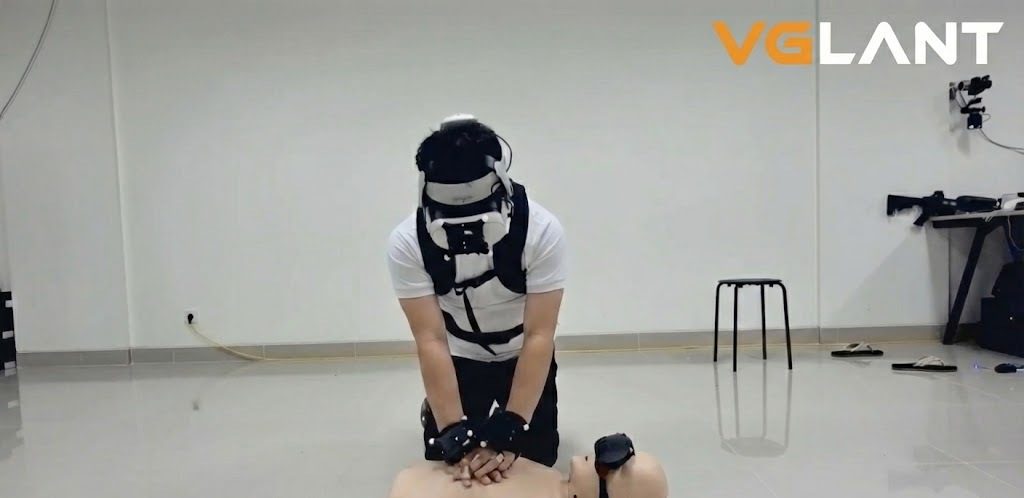
VGLANT’s first aid simulation generates parallel performance analytics: response initiation time (seconds from patient collapse detection to first aid action), CPR compression rate consistency (continuous measurement throughout the compression cycle, flagging deviations from the 100–120 per minute target), compression depth tracking, hand placement accuracy relative to the correct sternal position, airway assessment execution time, triage decision accuracy (correct prioritization of multiple casualties according to protocol), and wound management procedure compliance.
What VGLANT Calls “Trackable Performance”
VGLANT’s platform describes its analytics capability as “trackable performance” — the ability to monitor critical metrics including task duration, reaction time, and actions taken so that each session can be reviewed and benchmarked accurately. In assessment science terms, this represents a transition from criterion-referenced subjective evaluation (instructor judges performance against an internal standard) to norm-referenced objective measurement (software measures performance against quantified benchmarks). The scientific advantage is that objective measurement eliminates the inter-rater variance, attention constraints, and social biases that compromise subjective assessment.
Implications for Indonesian K3 Compliance and Beyond
Audit-Grade Documentation
For Indonesian companies subject to K3 audits by Disnaker inspectors, VGLANT’s telemetric records provide compliance documentation that is substantially more rigorous than conventional attendance sheets and checklist assessments. Each worker’s training history, performance metrics, competence scores, and progression over time are digitally archived and retrievable. This audit trail satisfies not only Permenaker documentation requirements but also the evidence-based competence assurance standards expected by international frameworks such as ISO 45001.
Cross-Site Competence Benchmarking
For companies operating across multiple Indonesian sites — a common operational structure in the mining sector where companies within the Virtu industrial network manage concessions spanning Kalimantan, Sumatra, and Papua — VGLANT’s standardized metrics enable direct cross-site competence comparison. Because every worker is assessed by identical software against identical benchmarks, a performance score from a remote Kalimantan mining site is directly comparable to a score from a Java manufacturing facility. This cross-site benchmarking capability is impossible with observational assessment due to inter-rater variance between different instructors at different locations.
Predictive Competence Management
VGLANT’s longitudinal performance data enables a proactive approach to competence management. By analyzing performance trends over multiple training sessions, HSE managers can identify workers whose fire safety or first aid metrics are trending downward before those workers fall below acceptable competence thresholds. This predictive capability transforms K3 training from a reactive annual compliance activity into a data-driven, continuous competence assurance program — a shift that aligns with the proactive risk management philosophy increasingly emphasized in Indonesian occupational safety regulation.
Conclusion
The measurement limitations of subjective observational assessment represent a structural weakness in Indonesian K3 fire safety and first aid compliance. VGLANT’s integrated performance analytics system addresses this weakness by replacing subjective instructor judgment with objective, automated telemetry that captures sub-second behavioral data, eliminates inter-rater variance, and provides audit-grade compliance documentation. For Indonesian industrial organizations seeking to transition from paper-based K3 compliance to evidence-based competence assurance, VGLANT’s data tracking and analytics capabilities provide the measurement infrastructure necessary to ensure that safety training documentation accurately reflects the genuine emergency response capability of the workforce.