

Mining remains one of the most dangerous industries in the world. The U.S. Bureau of Labor Statistics records fatality rates as high as 32.5 per 100,000 workers in coal mining, with transportation-related incidents identified as the leading cause of death across all mining subsectors. Globally, more than 15,000 mining-related injuries are reported every year, and the average financial impact of a single serious accident exceeds $4 million when accounting for medical expenses, equipment damage, lost productivity, and subsequent legal costs.
A significant portion of these incidents involves heavy-duty vehicles—haul trucks, excavators, dozers, and loaders—operated by personnel who have not yet developed the competence required for safe handling. The root cause is not negligence; it is the inherent limitation of conventional training methods that place inexperienced operators behind the controls of machines weighing 30 to over 200 tonnes.
This article examines how virtual reality simulation, specifically the heavy mining vehicle training programme developed by Virtu, addresses both the safety and financial dimensions of this challenge.
The Hidden Cost of Underprepared Operators
Training a new heavy equipment operator in the mining sector is an expensive undertaking by any standard. Industry estimates place the cost of formal operator training programmes between $5,000 and $20,000 per individual, excluding lost productivity during the learning period. When training takes place on live equipment, additional costs accumulate rapidly: large haul trucks burn approximately 200 litres of diesel per operating hour, equipment usage fees add $50 to $200 per training day, and the risk of accidental damage to machinery valued in the millions remains ever-present.
Yet the most significant cost is not financial—it is human. Data from the U.S. Mine Safety and Health Administration (MSHA) reveals that younger and less experienced workers face disproportionately higher fatality rates, particularly in transportation-related incidents. The same data shows that handling materials, machine maintenance, and powered haulage activities collectively account for nearly half of all recorded mining injuries. These are precisely the areas where operator inexperience has the greatest impact.
Evidence for VR Training Effectiveness
The case for VR-based operator training is no longer theoretical. A growing body of research and industry case studies demonstrates measurable improvements across multiple performance indicators.
A quasi-experimental study published in Scientific Reports involving 200 industrial participants found that VR-based training increased safety awareness by 30% and produced statistically significant improvements in risk perception and self-efficacy compared to traditional classroom instruction. Separate research indicates that immersive VR simulation generates a 45% improvement in knowledge retention relative to lecture-based methods.
At the operational level, the results are equally compelling. BHP, one of the world’s largest mining companies, reported a 40% acceleration in new employee onboarding after implementing VR-based equipment training. Goldcorp’s Éléonore mine in Quebec documented a 30% reduction in safety incidents. Mining operations that adopted VR for emergency evacuation drills achieved a 35% improvement in evacuation response times. In heavy manufacturing, one large-scale implementation recorded an 82% reduction in workplace accidents within a single year of VR safety training deployment.
How Virtu’s Programme Addresses Mining-Specific Needs
Generic VR training tools are not sufficient for the mining sector. Operating a 150-tonne haul truck is fundamentally different from operating a forklift or a crane. The startup sequence alone can involve 15 to 20 discrete steps, the cabin interface presents dozens of controls with no room for guesswork, and the operational environment—steep haul roads, confined loading zones, variable terrain—demands spatial awareness that cannot be developed in a classroom.
The Virtu VR training programme was engineered from the ground up for heavy mining vehicle operations. It follows a four-stage progressive structure, each targeting a competency domain where conventional training is most deficient.
Stage 1: Component Recognition
Trainees interact with a full-scale 3D replica of the target vehicle and learn to identify critical systems: powertrain assemblies, hydraulic circuits, cooling infrastructure, braking mechanisms, and suspension components. This mechanical literacy serves as the foundation for all subsequent training. An operator who understands a vehicle’s anatomy is far more likely to detect early-stage component degradation during routine operations—a capability that directly reduces unplanned maintenance costs and catastrophic equipment failures.
Stage 2: Inspection Procedure
MSHA records confirm that skipped or incomplete pre-shift inspections are a contributing factor in a significant proportion of equipment-related mining injuries. The second stage drills the walkaround protocol into trainees through guided repetition. In the virtual environment, operators navigate around the machine, open access panels, verify fluid levels, assess tyre and brake condition, and document their findings. The system automatically flags omitted steps, ensuring procedural compliance is reinforced consistently until the routine becomes instinctive.
Stage 3: Cabin Interface Mastery
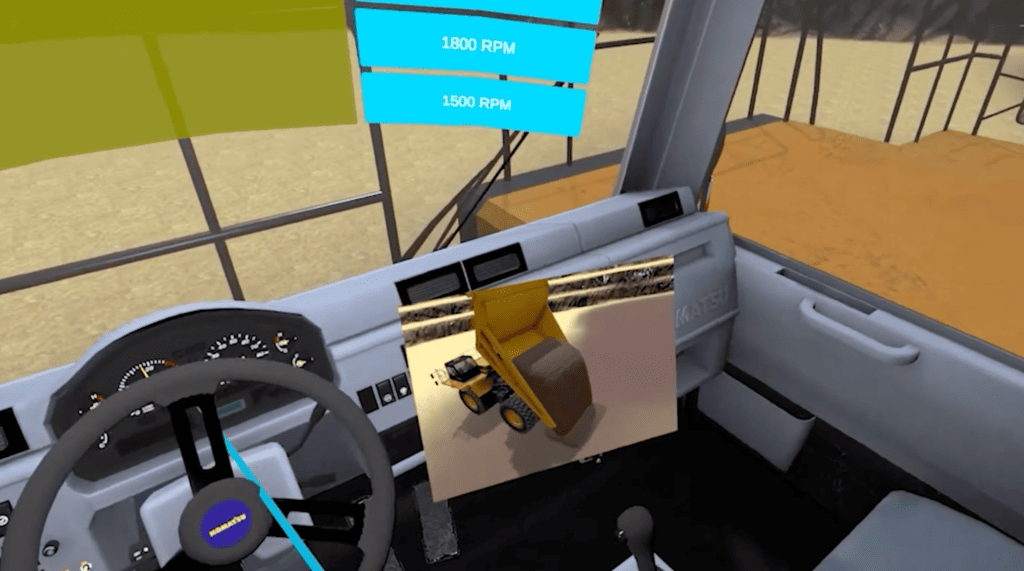
The Virtu platform replicates every element of the heavy vehicle cabin at 1:1 scale—joystick arrays, rocker switches, instrument clusters, multi-function displays, and warning indicators—all positioned exactly as they appear in the physical machine. Trainees practise the complete startup sequence, familiarise themselves with gauge readings and alert signals, and develop spatial memory of control locations. By the time an operator enters the real cabin for the first time, the interface is already familiar, substantially reducing the cognitive overload that contributes to errors during early field operations.
Stage 4: Operational Simulation
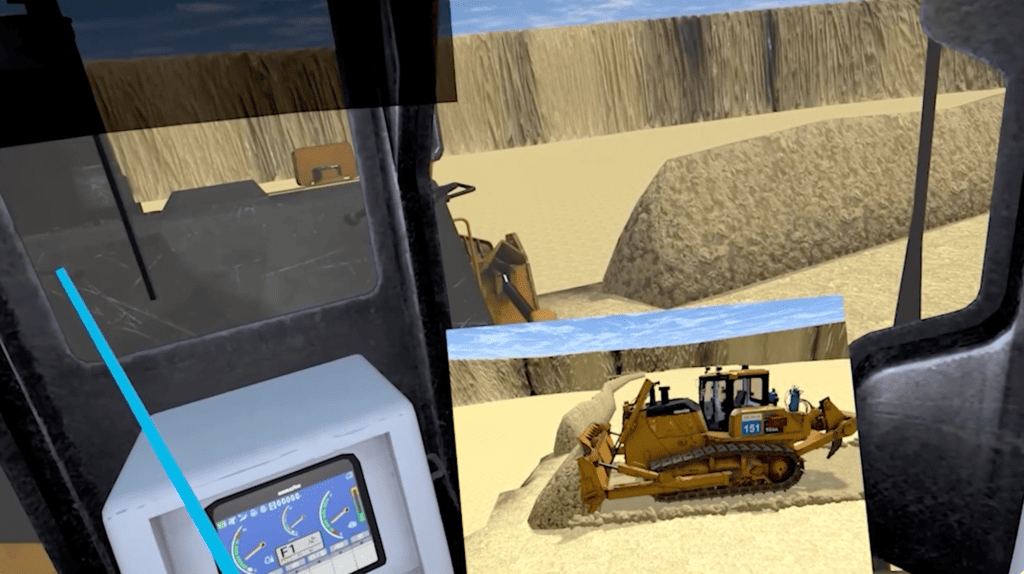
The final stage immerses operators in realistic mining work scenarios: loading material at the excavation face, navigating haul roads under proper speed and lane discipline, executing dump procedures, and responding to dynamic hazards such as stalled vehicles or road obstructions. Every input is captured by the system—steering precision, throttle management, reaction timing, procedural adherence—generating a comprehensive performance profile for each trainee.
Quantified Supervision Through Analytics
One of the most operationally significant features of the Virtu platform is the back-end analytics dashboard. Training evaluations in conventional programmes often rely on subjective instructor assessments—a practice that research consistently identifies as a source of inconsistent standards and advancement decisions based on opinion rather than evidence.
The Virtu dashboard captures granular data for every trainee: module completion rates, error frequency and type, time-per-task metrics, and procedural compliance scores. Supervisors can compare performance across cohorts, identify individuals who require additional practice on specific modules, and make certification decisions grounded in documented, auditable data. This systematic approach to competency assessment aligns with the broader industry shift toward evidence-based safety management.
Calculating the Return on Investment
The financial argument for VR-based mining operator training can be summarised in three dimensions. First, reduced equipment exposure during the learning phase eliminates fuel consumption, wear-and-tear costs, and the risk of damage to machinery valued in the millions. Second, faster onboarding—documented at up to 40% acceleration in comparable implementations—means new operators reach productive output sooner, directly recovering the investment in training infrastructure. Third, and most critically, fewer safety incidents translate into lower workers’ compensation claims, reduced insurance premiums, less operational downtime, and avoidance of the regulatory penalties and legal costs that follow serious accidents.
For mining operators evaluating the business case, the question is no longer whether VR training is justified—it is whether they can afford to continue without it.