The Failure of the Mannequin: Why High-Stakes First Aid Demands VR Immersion
Disasters don’t give warnings. When a severe emergency hits—whether on a remote mining concession, a high-density factory floor, or a post-earthquake zone—panic kills theory. Most traditional Health, Safety, and Environment (HSE) training is fundamentally broken. Relying on plastic dummies in a quiet, air-conditioned classroom doesn’t prepare a worker’s central nervous system for the chaos, the visual trauma, and the extreme time pressure of a real casualty.
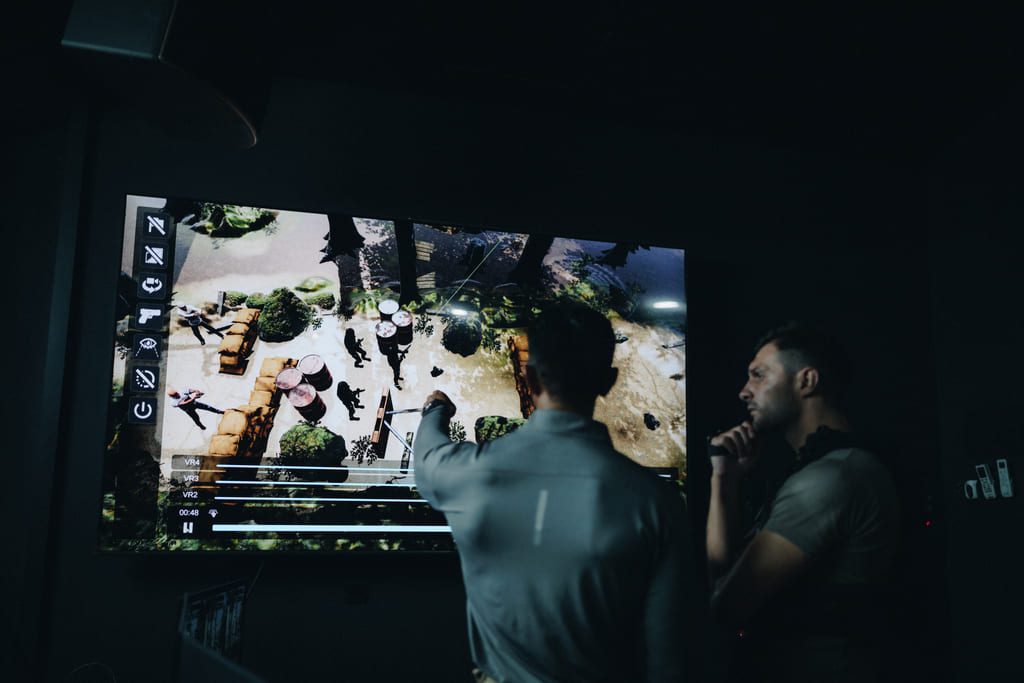
To bridge this lethal gap, VGLANT (by VIRTU) introduces the VR HSE First Aid & Disaster Response module. This isn’t just a simulation; it’s an engineered stress-test. It pulls trainees out of their comfort zones and drops them directly into a high-stakes crisis. It forces clear thinking through the adrenaline in a safe, yet intensely realistic, virtual environment.
1. Tactical Scenario: Medical Logistics in the “Red Zone”
This module immerses users in a high-fidelity, post-disaster environment. Dust-choked air, twisted rebar, and collapsed concrete are the baseline. Amidst this tension, the trainee isn’t a spectator; they are the primary responder.
The system demands immediate, mission-critical choices: Evacuation, First Aid, or Advanced Medical Procedures. Once the First Aid mission starts, the focus is singular: stabilize a severely injured victim before they expire. This environmental stress triggers the “freeze response,” allowing trainees to recognize and overcome it in a virtual space before it happens in the field.
2. Step-by-Step Life-Saving: The Tactical Workflow
VGLANT prioritizes “Kinetic Learning”—the idea that the body remembers what the mind might forget under pressure. Trainees execute emergency medical actions with surgical precision:
A. Triage and Visceral Assessment
The trainee approaches a victim lying on a medical stretcher. This patient displays realistic physical trauma—specifically, a massive laceration with arterial-style bleeding on the knee and thigh. Unlike a plastic mannequin, the virtual patient’s condition is dynamic. The trainee must bypass the initial shock and conduct an immediate visual observation. If the assessment takes too long, the victim’s vitals deteriorate. This is a harsh but necessary lesson in the “Golden Hour” of emergency medicine.
B. The Medical Backpack: Weaponizing Tool Recognition
Fumbling for tools is a leading cause of preventable death in the field. VGLANT equips users with a fully interactive, 3D-modeled medical backpack. Using VR hand controllers, the trainee must:
- Physically open the bag and navigate specialized compartments.
- Select specific equipment—ranging from medical scissors and triage tags (Immediate, Delayed, Minor, Deceased) to specialized gauze and pressure bandages.
- Manage time-to-retrieval, training the hand-eye coordination required to find the right tool when sight is obscured by smoke or debris.
C. Active Wound Treatment and Haptic Reflex
Knowing the tool is only half the battle; applying it under pressure is the goal. After retrieving the bandage, the user must physically apply it to the victim’s wound. The VR system tracks the exact spatial positioning of the trainee’s hands. You must apply the dressing to the correct pressure point with the correct motion. This kinetic experience hardwires the procedure as an automatic reflex. When the “real thing” happens, the body moves before the brain can panic.
3. Redefining HSE Standards: The VGLANT Competitive Edge
As a core brand under VIRTU, VGLANT focuses on the human impact. We transform theoretical knowledge into a survival instinct through three primary pillars:
- The Zero-Risk Sandbox: HSE teams practice managing arterial bleeding and disaster trauma without real-world risks or wasted physical supplies. You fail in the virtual world so you can be flawless when facing a real human life.
- Unlimited Spaced Repetition: Medical skills rot if they aren’t used. The VGLANT system allows for unlimited, cost-effective repetition. This drastically lowers the operational overhead of hiring live field instructors while maintaining a higher “readiness ceiling.”
- Tracked Data Records (TDR): The system is an uncompromising auditor. Every metric is logged—reaction times, tool selection accuracy, and the precise sequence of the medical procedure. HSE managers receive objective, actionable data. You no longer “hope” your team is ready; you have the data to prove it.
Conclusion: Don’t Wait for the Incident
Do not wait for a fatal event to realize your team was only prepared on paper. Standard compliance is not the same as survival readiness. Upgrade your safety protocols and transform your HSE culture from a “checked box” into a genuine life-saving force with VGLANT.